Choosing a provider for Steel Service Center Cutting affects more than the final dimensions. It can shape material yield, production schedules, and the consistency of every downstream part. The World Steel Association’s World Steel in Figures 2024 reports that global crude steel production reached about 1.89 billion tonnes in 2023. That scale reflects a broad, varied supply chain—not a guarantee that every center can meet your specifications.
Look beyond the equipment list. Ask whether the center regularly cuts your grade, thickness, and order volume. Check its stated tolerances against your drawing, and ask how it controls burrs, flatness, and edge quality. A neat sample is useful. A documented process is better. Request sample inspection records, material test reports, and heat or lot traceability where your application requires them. Confirm how the shop protects surfaces and labels bundles; a scratched sheet or unclear tag can create trouble before fabrication even begins.
The World Steel Association’s Short Range Outlook also tracks changing steel demand, a reminder that market conditions can shift lead times and availability. Ask suppliers how they communicate delays and manage replacement material. Compare total cost, including scrap, handling, packaging, and freight—not just the quoted cutting rate. Then test a small order, if practical. It may reveal a gap between stated capability and shop-floor results. A caution: published industry figures describe the market, not an individual service center. Verify claims with current records, clear acceptance criteria, and a conversation with the people who will handle your order. That takes time. It is worth it.
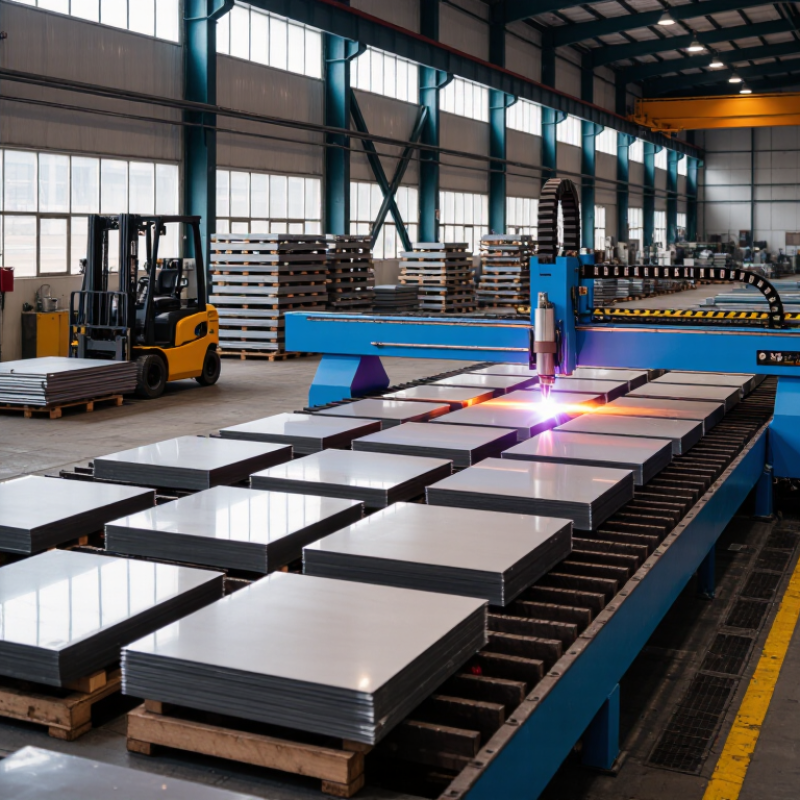
When requesting cutting, state the exact steel grade and governing specification, not just “mild steel.” World Steel Association’s World Steel in Figures 2024 reports 1,892.2 million tonnes of crude steel production in 2023, reflecting a vast supply chain, not identical material properties. Ask for the mill test report and confirm the grade, heat number, and required condition match your order. Small differences matter. If the part will be welded or machined, tell the service center; those operations can affect which grade and cutting method suit the job.
Give thickness in a clear unit and identify whether it is nominal or a minimum requirement. Then specify ASTM A6/A6M for applicable structural shapes, plates, bars, or sheet piling, and state whether standard tolerances are acceptable. ASTM A6/A6M sets dimensional and mass tolerances by product form and size; one generic tolerance will not cover every plate. Check the source. Ask how incoming thickness is verified and where measurements are taken, especially near plate edges. Cutting cannot correct parent material that falls outside the agreed tolerance. It is easy to assume a cut piece will match the drawing, but kerf, edge condition, and nesting can affect the usable dimensions. Put the finished-part tolerance and any tighter-than-standard requirement on the purchase order.
State the exact grade, governing specification, and required material condition. Include the heat number requirements. Small differences matter.
Give the thickness with a clear unit. Say whether it is nominal or a minimum, and identify any tighter tolerance needed.
Request a mill test report. Check that the grade, heat number, and condition match your order.
Compare its equipment range with your grade and thickness. Ask what tolerance it can hold for your part and batch size. Get it in writing.
A sheet that barely fits may need extra handling or a different cutting plan. Confirm usable bed dimensions and loading limits.
Ask how parts are arranged on each plate. Request a similar-job report showing usable material and scrap assumptions. A small layout change can matter.
Kerf is the material removed during cutting. It varies with thickness, equipment, and method, so confirm the allowance in the quote.
Ask whether usable remnants are returned, reused, or counted as waste. Confirm how parts are measured and where incoming thickness is checked. I may be overchecking this, but estimates can miss.
Choosing a steel service center for cutting starts with clearly defining the steel grade, thickness, dimensions, and applicable ASTM A6/A6M tolerances. These details help ensure the material and finished parts meet project requirements. Ask how the center selects thermal cutting processes and whether its quality controls align with the relevant ISO 9013:2017 quality classes, since edge quality and dimensional accuracy can vary by method and class.
Compare equipment capacity using maximum thickness, cutting-bed size, and demonstrated tolerance performance. Also review nesting practices, material yield, kerf width, and scrap rates to understand how efficiently each order will be processed. Before selecting a provider, confirm that mill test reports can be traced to supplied material, inspect how parts are checked, and assess on-time delivery performance. A capable Steel Service Center Cutting partner should communicate these measures clearly and consistently, helping you balance quality, material use, and dependable lead times.