engineered for high-throughput production lines, tight dimensional tolerances, and multi-material versatility.
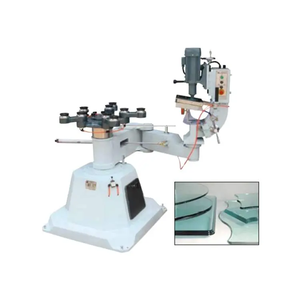
Designed for automated contour tracking and seamless seam welding on cylindrical, oval, and complex curved components with ultra-low thermal distortion.
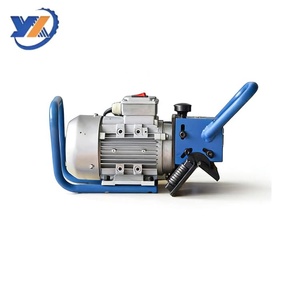
Heavy-duty laser joint preparation and high-speed rotary welding for carbon steel, stainless steel, and alloy pipes across varied wall thicknesses.
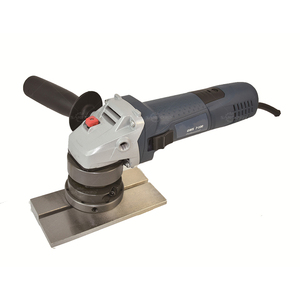
Ergonomic handheld wobbling laser head with auto wire feeder. Ideal for sheet metal fabrication, corner joints, and rapid on-site maintenance.
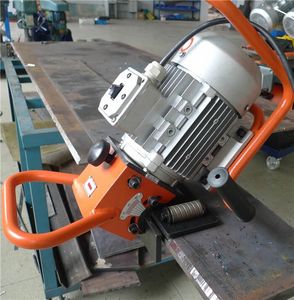
Adjustable-angle edge joining tool providing smooth seam bead geometry, deep penetration welds, and minimal post-weld grinding requirements.
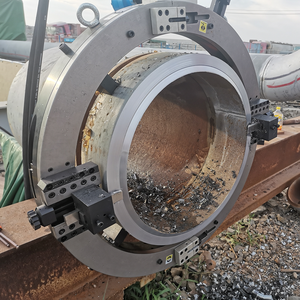
OD-mounted clamshell system engineered for cold cutting, beveling, and orbital laser welding of high-pressure process piping (22–28 inch).
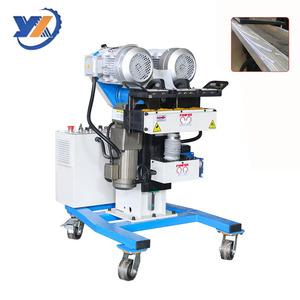
High-rigidity gantry system combining precision edge milling with high-power fiber laser welding for heavy steel plate processing.
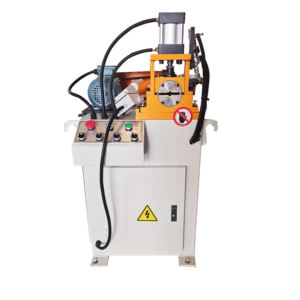
Optimized for stainless steel and carbon steel tube processing, featuring automated part feeding, laser seam fusion, and chamfer finishing.
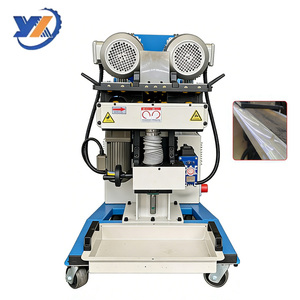
Industrial robotic cell integrated with real-time vision seam tracking, automatic wire feed, and multi-axis interpolation for OEM assembly lines.
An authoritative guide for procurement leaders, systems integrators, and industrial manufacturing directors evaluating fiber laser joining technologies.
As global industrial manufacturing pivots toward lightweight alloys, tight geometric tolerances, and energy-efficient processing, traditional joining methods such as Tungsten Inert Gas (TIG) and Metal Inert Gas (MIG) welding face significant economic and operational bottlenecks. The modern manufacturing ecosystem demands higher joining velocities, reduced Heat-Affected Zones (HAZ), zero post-weld grinding requirements, and total process repeatability. As a premier Custom OEM Laser Welder Manufacturer & Factory, our facility bridges the gap between fundamental laser physics and practical factory-floor execution.
“Information Gain Advantage: High-power fiber laser welding reduces total heat input by up to 80% compared to conventional arc processes, directly eliminating structural distortion and reducing post-process rework costs by up to 65% in sheet metal fabrication.”
The performance of a custom OEM laser welding machine is defined by optical power density (W/cm²), beam quality factor ($M^2$), and dynamic motion control synchronization. Unlike conventional arc welding, where heat is conducted radially from an electric arc, laser welding operates via two distinct thermal regimes:
Drawing on our legacy dating back to 1986 in Nottingham, England—where our engineering teams first refined high-precision gantry motion structures—every OEM laser welder frame is stress-relieved, precision-milled, and assembled under rigorous quality control standards. We integrate premium fiber laser sources (IPG, Raycus, Maxphotonics) with advanced dual-axis wobble optical heads and real-time gas regulation consoles.
By keeping structural fabrication, electrical panel wiring, optical alignment, and software control logic entirely under one roof, we provide enterprise customers with complete supply chain transparency and verifiable engineering provenance.
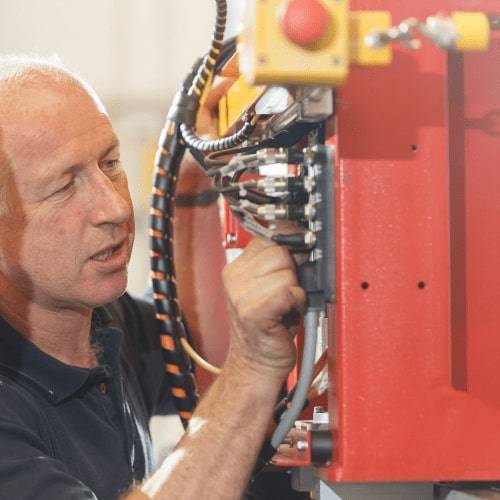
When selecting a custom OEM manufacturing partner for industrial laser welders, engineering specifications must align with duty cycle demands, target metallurgical properties, and factory automation architecture:
Single-axis and dual-axis oscillating wobble heads expand the effective beam spot diameter from 0.2mm up to 5.0mm. This bridges variable gap tolerances in sheet metal assemblies and prevents burn-through while creating consistent, high-strength weld fillets.
Integrated digital wire feeders dynamically sync wire delivery speed (0–8 m/min) with laser pulse frequency. Ideal for thick plate structural joints, dissimilar material bridging, and multi-pass bevel filling.
Real-time optical vision systems track joint seam deviations down to $\pm 0.02 \text{ mm}$, automatically steering 6-axis robotic arms or Cartesian gantries to maintain perfect laser focal alignment during high-speed continuous runs.
Quantitative benchmarks derived from 35+ years of operational machine performance and metallurgical testing.
| Performance Metric | Handheld Wobble Fiber Laser | 3-Axis CNC Laser Welder | 6-Axis Robotic Laser Cell | Traditional TIG / MIG Welding |
|---|---|---|---|---|
| Typical Power Range | 1,000W – 3,000W | 1,500W – 6,000W | 2,000W – 12,000W | N/A (200A – 500A Arc) |
| Welding Velocity (1.5mm Stainless) | 35 – 80 mm/sec | 50 – 120 mm/sec | 60 – 200 mm/sec | 5 – 12 mm/sec |
| Heat-Affected Zone (HAZ) | Ultra-Narrow (< 0.5 mm) | Narrow (< 0.3 mm) | Micro-Narrow (< 0.2 mm) | Wide (3.0 – 8.0 mm) |
| Thermal Distortion | Negligible | Zero Distortion | Zero Distortion | Severe (Requires Straightening) |
| Operator Skill Dependency | Low (1-Day Training) | Medium (NC Programming) | Low (Automated Cell) | Very High (Certified Welder) |
| Post-Weld Finishing Required | None to Minimal | None | None | Heavy Grinding & Polishing |
Combining rigorous British engineering compliance, proven laser optic integration, and flexible custom white-label manufacturing.
We do not merely supply off-the-shelf equipment. As an established OEM factory, we co-engineer machinery tailored to your exact brand aesthetics, physical footprint specifications, electrical voltage compliance (380V 3-Phase, 220V Single-Phase, 480V US Standard), and CNC interface language localization.
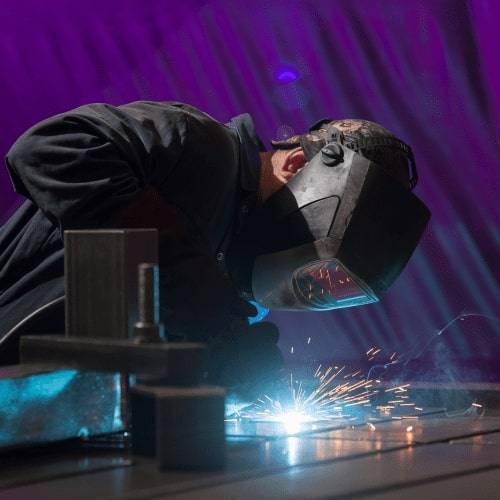
Every custom OEM laser welder produced at our manufacturing hub undergoes rigorous multi-stage validation prior to export:
Strategic technology insights for industrial buyers seeking future-proof manufacturing assets.
Procurement directors in aerospace, automotive, battery energy storage systems (BESS), and HVAC equipment are witnessing a fundamental shift in laser joining capabilities. When specifying custom laser welding machines for upcoming production cycles, forward-looking enterprises are prioritizing four distinct technology vectors:
Standard infrared fiber lasers (1064nm wavelength) face physical absorption constraints when joining highly reflective non-ferrous metals like pure copper ($Cu$) and gold ($Au$), absorbing less than 5% of laser energy at room temperature. The integration of Blue (450nm) and Green (515nm) hybrid laser beams elevates initial absorption to over 65%. This eliminates spatter, prevents micro-void formation, and enables conductive copper hair-pin welding in electric vehicle (EV) motor manufacturing.
Modern OEM laser welding lines are shifting from post-process destructive testing to real-time optical emission analysis. By embedding photodiodes, acoustic emission sensors, and high-speed thermal cameras directly into the laser optic head, edge-computing algorithms detect keyhole collapse, humping, and pore formation instantaneously—flagging non-conforming parts without interrupting line cadence.
While traditional 1.5kW–3kW handheld laser welders require water chillers—increasing overall cabinet weight to over 250kg—next-generation air-cooled laser architectures reduce total system weight below 60kg. Procurement trends show rapid adoption of these compact units in field maintenance, structural HVAC installation, and modular construction site assembly.
Factory automation projects are replacing custom-coded PLC programming with standardized ROS-based (Robot Operating System) software controllers. Pre-configured OEM laser welding cells feature drag-and-teach path programming, allowing operators to set complex 3D weld trajectories in minutes rather than days.
Real-world feedback from high-volume structural metal processors and precision components manufacturers.
“Having operated custom automated processing machinery built by this engineering team over an 8-year span, we bought two additional automated welding units. The mechanical rigidity and joint consistency across both thin sheet and heavy plate processing are exceptional. Technical support is prompt and dependable.”

“Our catalyst component production requires precise, leak-tight perimeter seams on thin stainless steel housings. Integrating four custom laser welding stations boosted our production volume exponentially while keeping scrap rates below 0.1%.”

“The custom laser welder transformed our shop floor. Within 18 months of commissioning, the machine paid for itself entirely by eliminating three post-weld grinding positions and reducing gas consumption significantly.”

In-depth technical answers to common queries raised by equipment distributors, OEMs, and factory managers.
Partner directly with an established laser machine tool factory. Submit your material specifications, material thickness ranges, and output targets for a detailed technical quote and process feasibility study within 24 hours.