Benchmarked for kerf tolerance, chuck dynamics, wall-thickness adaptability, and overall lifecycle ROI.
An executive whitepaper on how multi-axis fiber lasers, zero-tailing chucks, and dynamic CAD/CAM software are redefining structural pipe processing productivity.
Traditional 2D perpendicular laser cutting is rapidly being replaced by 5-axis 3D bevel heads capable of ±45° angular cuts. This eliminates secondary mechanical beveling, allowing tubes to be welded immediately upon leaving the laser bed with zero manual edge preparation.
Raw metal tubing represents over 60% of total job expenses. Advanced 3-chuck and 4-chuck system architectures move material dynamically through the cutting zone, reducing un-cut tailing waste to practically zero millimeters per bar length.
With fiber laser power expanding from 3kW up to 20kW+, manufacturers can process heavy structural steel pipe (up to 25mm wall thickness) at speeds that surpass traditional mechanical sawing, milling, and plasma cutting by a factor of 4x.
Comprehensive ROI comparison based on 100,000 meters of annual structural steel pipe production.
| Evaluation Parameter | Automated CNC Tube Fiber Laser | Mechanical Saw + Manual Beveling | Conventional Plasma Tube Cutter |
|---|---|---|---|
| Edge Quality & Kerf Width | Ultra-smooth (Ra < 3.2 µm), kerf 0.15–0.3mm | Rough saw teeth marks, wide kerf loss (>2.5mm) | Dross formation, wide heat-affected zone (HAZ) |
| Complex Geometry & Slots | Instant 3D profiling, intersecting joints, slots | Requires secondary milling, drilling & punching | Limited to basic contour cuts and coarse holes |
| Processing Speed (Thin-Mid Tube) | Extremely High (Up to 45 m/min line speed) | Slow mechanical feeds + manual setup changeovers | Moderate cutting speeds, high thermal lag |
| Material Scrap Rate | Near Zero (<1% with 4-chuck intelligent nesting) | High (150mm – 300mm scrap end-offs per tube) | Moderate (50mm – 120mm tailing remnants) |
| Operational Labor Cost | Single operator for fully automated bundle loading | 3 to 5 workers across sawing, deburring, and milling | 2 operators needed for slag cleanup & fitting |
Key technical criteria that global EPC contractors and metal service centers must evaluate before placing capital equipment orders.
Manual loading creates severe throughput bottlenecks. Leading tube laser factories now integrate automatic pneumatic bundle sorters capable of feeding round, square, rectangular, and open-profile channels (H/U/L beams) automatically into the chuck jaws without manual operator intervention.
Modern tube laser cutting is directly tied to automated nesting algorithms (such as Lantek, TubesT, or SigmaNEST). Intelligent nesting maximizes raw tube yield by nesting complex saddle cuts, mortise-and-tenon joint interlocks, and drainage slots into single seamless runs.
Procurement trends show a growing demand for heavy-pipe processing equipment. Factories are upgrading from standard 160mm capacity machines to heavy-duty 350mm, 500mm, and even 800mm OD machines carrying pipe payloads exceeding 3.5 metric tons per length.
Founded by elite engineering graduates in Nottingham, England, our legacy is built on full structural control: every machine bed is welded, stress-relieved, machined, wired, and cut-tested under a single roof to guarantee lifelong dynamic accuracy.
Partnering directly with leading global power innovators—such as Hypertherm for high-definition plasma/flame systems and top-tier European fiber optic developers—we bridge the gap between heavy metal fabrication and micro-precision digital control.
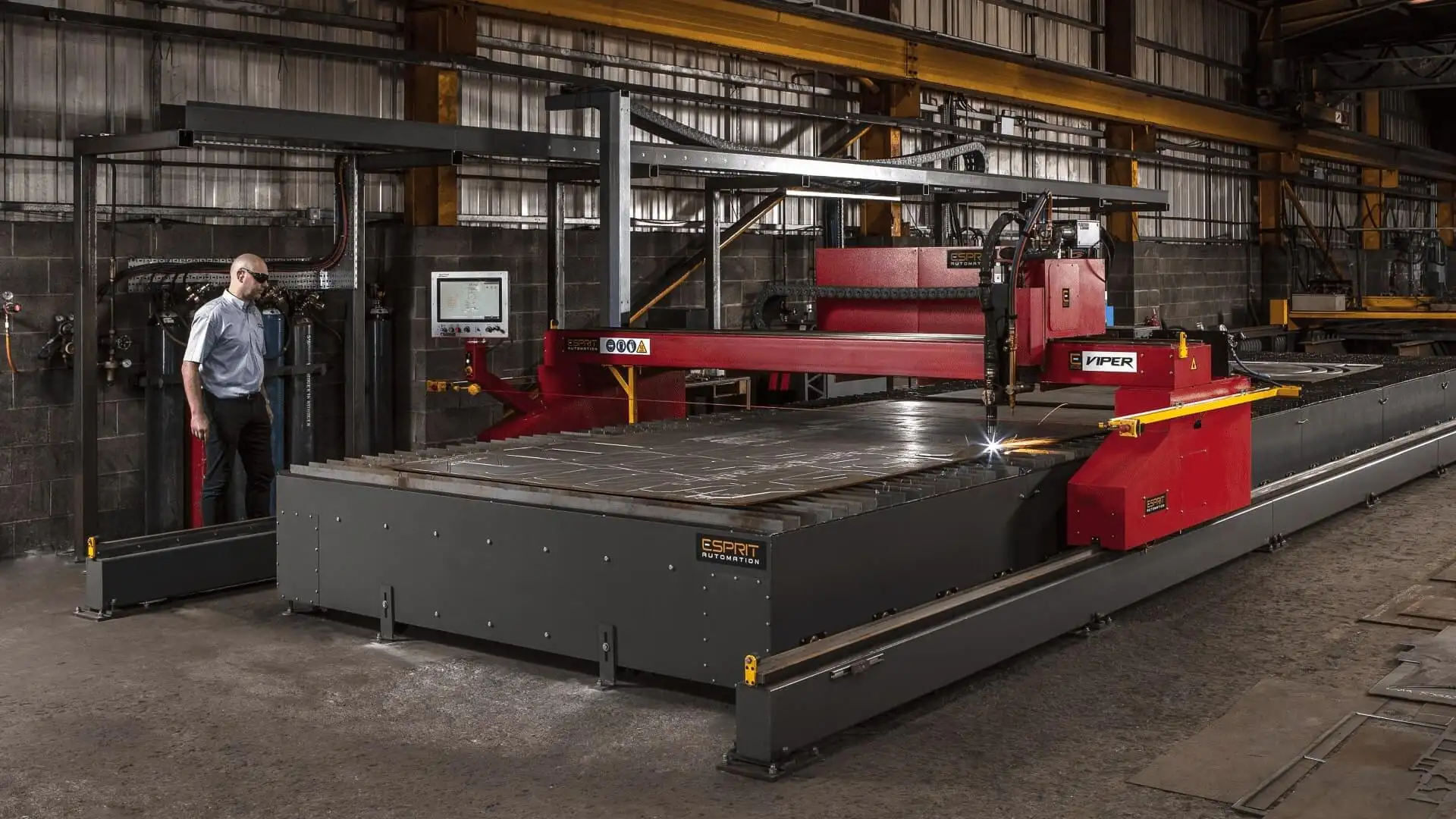
Clear, unvarnished insight from experienced laser automation engineers to assist your factory purchasing decisions.
Choosing the correct chuck configuration depends heavily on your raw material costs and part length requirements:
For thin-wall tubing (1mm – 3mm mild steel/stainless), a 3kW to 4kW fiber laser source delivers maximum cutting speeds. If your work involves mid-range wall thicknesses (4mm – 10mm), a 6kW or 8kW source is optimal. For heavy structural steel sections, H-beams, and thick-wall mechanical piping above 12mm wall thickness, a 12kW to 20kW fiber laser is recommended to maintain clean piercing times and high-speed 3D beveling.
Yes, provided the machine is equipped with 3D profile recognition software, specialized open-chuck jaw inserts, and a floating capacitive height sensor head. Specialized 3D 5-axis tube lasers dynamically adjust focal lengths and head orientation to compensate for dimensional variations across structural channels and angle steel.
Laser tube processing provides extreme positional precision (±0.03mm) along with intricate joint features such as self-locating tab-and-slot (mortise & tenon) designs. Tubes snap together seamlessly prior to welding, eliminating expensive measurement fixtures and reducing welder fitting times by up to 70%.
High-power fiber laser processing generates toxic metal fumes and micro-particles. Every compliant tube laser installation requires a fully enclosed laser safety housing (Class 1 laser rating) paired with an automated multi-zone downdraft dust collector and HEPA fume filtration unit to meet stringent workplace safety standards.
Every system includes integrated IoT remote telemetry diagnostics. Our factory engineers can inspect CNC drive parameters, optical sensor health, gas pressure levels, and software post-processors in real-time over secure cloud channels, ensuring immediate technical resolution anywhere in the world.
Consult with our lead application engineers to benchmark your CAD drawings, calculate cost-per-part savings, and receive a customized technical proposal.